DIGNITY BY DESIGN
Transforming Sanitation and Restoring Hope in Ga Mashie
A Comprehensive Project Report on the 175 Bio-Digester Initiative
Implementing Partners: Nurture Nature Foundation (NNF) & Ga Mashie Development
Agency (GAMADA)
Lead Funder: Selavip (Belgium)
Project Site: Ga Mashie (Jamestown & Ussher Town), Accra, Ghana
Date of Launch: May 4, 2026
TABLE OF CONTENTS
FRONT MATTER
1. Title Page
2. Foreword by Dr. Alfred Dodoo (Director of GAMADA)
3. Executive Summary: The 175-Unit Vision
PART I: THE CONTEXT OF GA MASHIE
4. Chapter 1: The Historical Heart of Accra
– The Anthropology of Ga Mashie
– From Colonial Hub to Urban Marginalization
5. Chapter 2: The Sanitation Crisis
– The Sociology of the “Compound House”
– The Economics of Public Latrines: The “Poverty Penalty”
– The Public Health Emergency: Cholera and Typhoid Data
PART II: THE INTERVENTION
6. Chapter 3: The Nurture Nature Foundation Vision
– Peter Asiedu and the Philosophy of “Nurturing Nature”
– The “Blue Economy”: Sanitation as a Tourism Catalyst
7. Chapter 4: The Science of the Bio-Digester
– Engineering Specifications and Design
– Why Bio-Digesters? A Comparison with Traditional Systems
– The Pilot Phase: Proof of Concept in Three Households
PART III: PARTNERSHIPS AND PHILANTHROPY
8. Chapter 5: The Role of Selavip (Belgium)
– International Solidarity for Housing and Sanitation
– The Grant Allocation and Fiduciary Responsibility
9. Chapter 6: Local Governance and Leadership
– GAMADA: The Engine of Development
– The Assembly’s Role: Carlos Nii Ayaa Mankattah and the Kinka Electoral
Area
PART IV: HUMAN IMPACT AND TESTIMONIALS
10. Chapter 7: Restoration of Human Dignity
– The Case of Naa Adoley: A Matriarch’s Relief
– Safety for Women and Children in Urban Alleys
11. Chapter 8: Social Engineering and Behavioral Change
– Overcoming the Habit of Open Defecation
– Community Town Halls and Education
PART V: SUSTAINABILITY AND SCALING
12. Chapter 9: The Maintenance Ecosystem
– Training the Five-Member Technician Team
– The Operational and Maintenance (O&M) Roadmap
13. Chapter 10: The Roadmap to 1,000 Households
– Closing the Funding Gap: A Call to Corporate Ghana
– Replicating the Ga Mashie Model Nationally
BACK MATTER
14. Conclusion: A New Dawn for Jamestown
15. Appendices: Technical Drawings and Budgetary Frameworks
FOREWORD
By Dr. Alfred Dodoo, Director of GAMADA
As the Director of the Ga Mashie Development Agency (GAMADA), I have witnessedmany initiatives come and go, but few carry the transformative weight of the Ga Mashie Sanitation Transformation Project. When the Nurture Nature Foundation approached us with the backing of Selavip, we recognized a rare alignment of technical innovation and humanitarian empathy.
I express my profound excitement and hope for this project. For the people of Jamestown and the wider Ga Mashie community, this is more than just the installation of 175 toilets; it is the restoration of hope. For too long, our people have lived in the shadow of neglect, facing the daily indignity of lacking basic sanitation. This project, led by the Nurture Nature Foundation, is a beacon that signals a new era. It tells our people that their health matters, their dignity is non-negotiable, and their future is bright. We are not just building toilets; we are building a foundation for a revitalized, healthy, and prosperous Ga Mashie.
EXECUTIVE SUMMARY
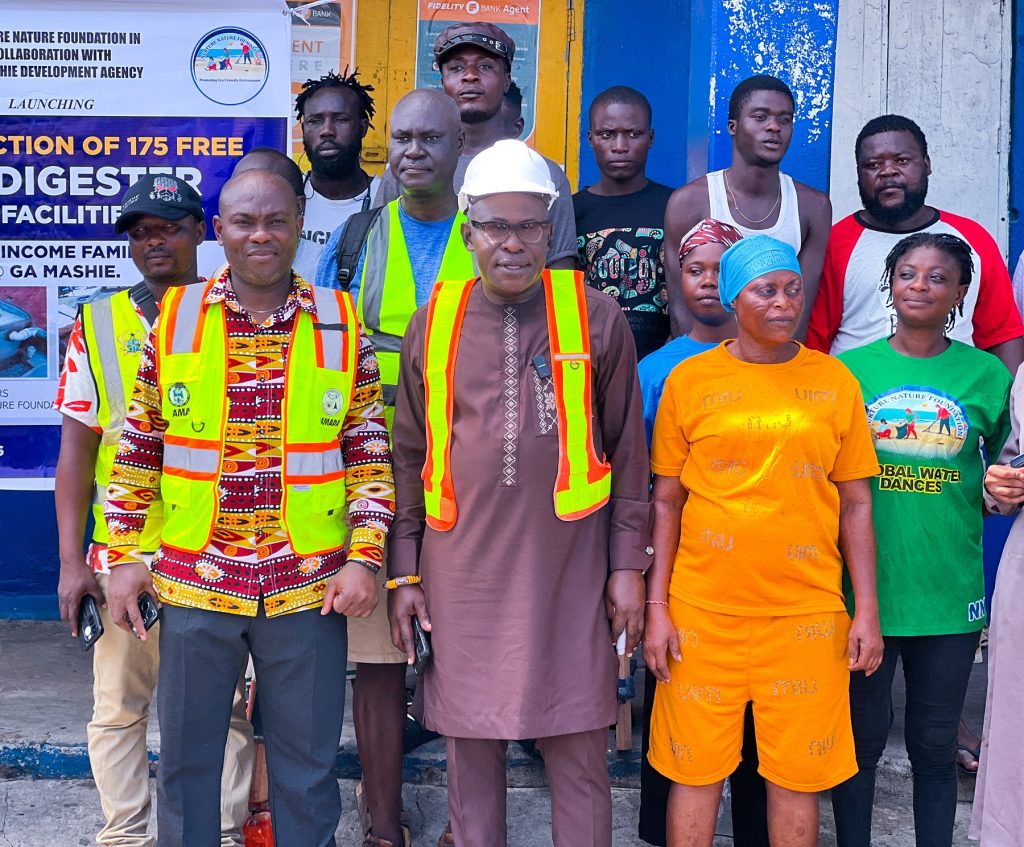
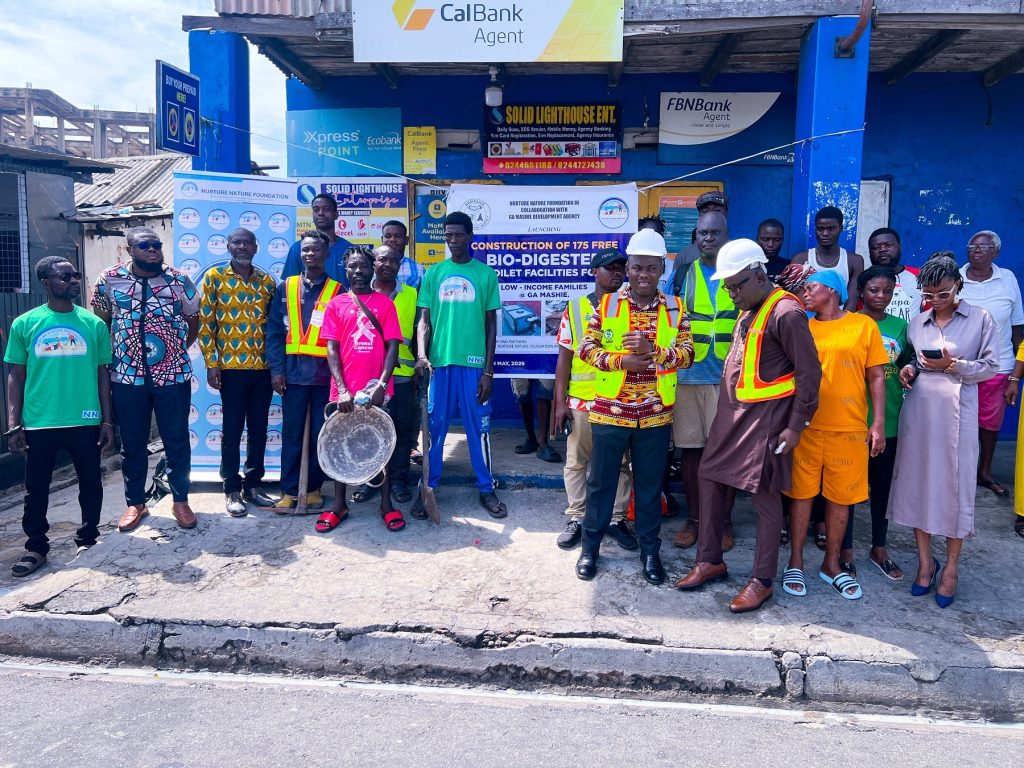
The Ga Mashie Sanitation Transformation Project represents a strategic intervention in one of Accra’s most densely populated and historically significant enclaves. Officially launched on Monday, May 3, 2026, the project seeks to eliminate the practice of open defecation by providing 175 free, high-tech bio-digester toilet facilities to low-income households.
Backed by a grant from the Belgian NGO Selavip and implemented through a partnership between the Nurture Nature Foundation (NNF) and the Ga Mashie Development Agency (GAMADA), the project has already moved past the theoretical stage. At the time of launch, three pilot units were fully operational, providing immediate proof of the technology’s efficacy. With a long-term goal of reaching 1,000 households and a dedicated program to train local technicians, the project is designed for both immediate impact and decadal sustainability.
This report serves as the official documentation of the project’s design, implementation, and visionary goals.
PART I: THE CONTEXT OF GA MASHIE
CHAPTER 1: THE HISTORICAL HEART OF ACCRA
1.1 The Anthropology of Ga Mashie
Ga Mashie is not merely a geographic location; it is the soul of the Ga people. Bordered by the Atlantic Ocean to the south, it encompasses the historical districts of Jamestown and Ussher Town. Its streets are lined with the remnants of colonial architecture—the lighthouse, the forts, and the old trading houses—each whispering stories of a time when this was the epicenter of West African commerce.
However, the socio-economic reality of modern Ga Mashie is one of stark contrasts. As Accra expanded, the administrative and commercial weight shifted to the north and east, leaving Ga Mashie to grapple with extreme population density. Today, the community is characterized by “compound houses,” where 30 to 50 residents may share a single dwelling. In this environment, infrastructure has failed to keep pace with human growth, leading to the crisis this project intends to solve.
1.2 From Colonial Hub to Urban Marginalization
The decline of infrastructure in Ga Mashie is a case study in urban marginalization. The shift from a colonial administrative hub to a neglected urban enclave resulted in a “sanitation vacuum.” The lack of land space makes the installation of traditional, large-scale sewerage systems almost impossible.
The Nurture Nature Foundation recognized that any solution must be decentralized—brought directly into the homes of the people, rather than relying on a central grid that may never come.
CHAPTER 2: THE SANITATION CRISIS
2.1 The Sociology of the “Compound House”
Space Clottey, Deputy Executive Director of GAMADA, provided a vivid description of the daily struggle during the project launch. “Sometimes a house of 30 people has no toilet facility whatsoever,” he lamented. In these compound houses, the lack of a toilet is not just a health issue; it is a social one. It creates a “queuing culture” at public latrines, where residents lose productive hours just waiting to ease themselves.
2.2 The Economics of Public Latrines: The “Poverty Penalty”
Perhaps the most heartbreaking aspect of the sanitation crisis is the financial burden on the poorest residents. Public toilets in Ga Mashie charge a fee for every use. For a family living on less than $2 a day, the cost of five people using a public facility multiple times can consume 20% of their daily income.
This “poverty penalty” is what drives the practice of open defecation on the beaches—it is not a choice of preference, but a choice of survival.
2.3 The Public Health Emergency
The health implications are dire. Ga Mashie has historically been a hotspot for cholera and typhoid outbreaks. The proximity of untreated human waste to cooking areas and the ocean (where fish are landed) creates a cycle of reinfection that keeps the community in a state of “health poverty.” Peter Asiedu of NNF noted that by providing these 175 units, the project is essentially performing “preventative medicine” on a community scale.
PART II: THE INTERVENTION
CHAPTER 3: THE NURTURE NATURE FOUNDATION VISION
3.1 Peter Asiedu and the Philosophy of “Nurturing Nature”
At the launch, Peter Asiedu, Executive Director of the Nurture Nature Foundation, articulated a vision that goes beyond plumbing. His philosophy is rooted in the belief that human dignity and environmental health are inseparable. “We want the beaches to be a tourist attraction center. We want our communities to be clean,” Asiedu stated.
The Foundation’s approach is tripartite:
1. Hardware: The physical bio-digester units.
2. Software: Education and behavioral change.
3. Orgware: The training of local maintenance teams to ensure the hardware
never fails.
3.2 The “Blue Economy”: Sanitation as a Tourism Catalyst
The Nurture Nature Foundation views sanitation as the first step toward a “BlueEconomy” for Jamestown. By ending open defecation on the beaches, the coastline can be reclaimed for tourism. A clean Jamestown beach could rival any in thesub-region, bringing in hotels, restaurants, and jobs. Asiedu’s vision is thatthe toilet in a home in Ga Mashie is the “seed” from which amulti-million-dollar tourism industry will grow.
CHAPTER 4: THE SCIENCE OF THE BIO-DIGESTER
4.1 Engineering Specifications and Design
The bio-digester technology selected for this project is specifically engineer for high-density, low-income urban environments. Unlike a septic tank, which stores waste, a bio-digester treats it.
- The Chamber: A compact concrete or high-density plastic unit that occupies less than 1/4 of the space of a traditional septic tank.
- The Media: Layers of activated charcoal, coconut husks, and specialized sand that act as a habitat for aerobic bacteria.
- The Process: When waste enters the chamber, the bacteria break down the solids into a liquid effluent that is 98% free of pathogens and odorless.
- This liquid is then safely discharged into a small soak-away or used for irrigation.
4.2 Why Bio-Digesters?
The choice of bio-digester technology was deliberate.
- Space Saving: In the cramped alleys of Ga Mashie, there is no room for large soak-aways.
- Cost-Effective: They do not require the frequent and expensive “dislodging” (pumping out) that septic tanks do.
- Odorless: This was critical for household acceptance in crowded compounds.
4.3 The Pilot Phase: Proof of Concept
Prior to the May 3rd launch, three units were installed to test the community’s reaction and the technology’s resilience. The media team’s visit to these households confirmed that the units were in active use and, most importantly, were completely odorless and functioning perfectly despite the high volume of users in each house. This pilot phase gave Selavip the confidence to fund the full 175-unit rollout.
PART III: PARTNERSHIPS AND PHILANTHROPY
CHAPTER 5: THE ROLE OF SELAVIP (BELGIUM)
5.1 International Solidarity for Urban Sanitation
The realization of the Ga Mashie Sanitation Transformation Project would have remained a distant dream without the intervention of Selavip, a Belgian non-governmental organization with a storied history of supporting housing and sanitation projects for the world’s most vulnerable populations. Selavip’s philosophy is rooted in the belief that “a house is not a home without dignity,” and in the 21st century, dignity is fundamentally linked to access to clean water and private sanitation.
The grant provided for the 175 bio-digester units represents a significant capital injection into the Jamestown community. However, Selavip’s contribution goes beyond the financial. By selecting the Nurture Nature Foundation as its implementing partner, Selavip signaled its confidence in local African leadership to solve African challenges. This partnership is a model of “South-North Cooperation,” where international resources are combined with local technical expertise and community trust to create a sustainable outcome.
5.2 The Fiduciary Responsibility and Selection Process
The funding process was rigorous. Selavip requires its partners to demonstrate not only technical competence but also social equity. The 175 units were not distributed at random; they were targeted at households that fell below the “Sanitation Poverty Line.”
During the launch, Peter Asiedu, Executive Director of NNF, highlighted the weight of this responsibility. The grant was managed through a transparent procurement process, ensuring that every Cedi and Euro was maximized. The use of bio-digester technology—which has a longer lifespan and lower maintenance cost than traditional systems—was a key factor in Selavip’s decision to fund the project, as it ensured the highest “Return on Human Dignity” for their investment.
CHAPTER 6: LOCAL GOVERNANCE AND LEADERSHIP
6.1 GAMADA: The Engine of Local Development
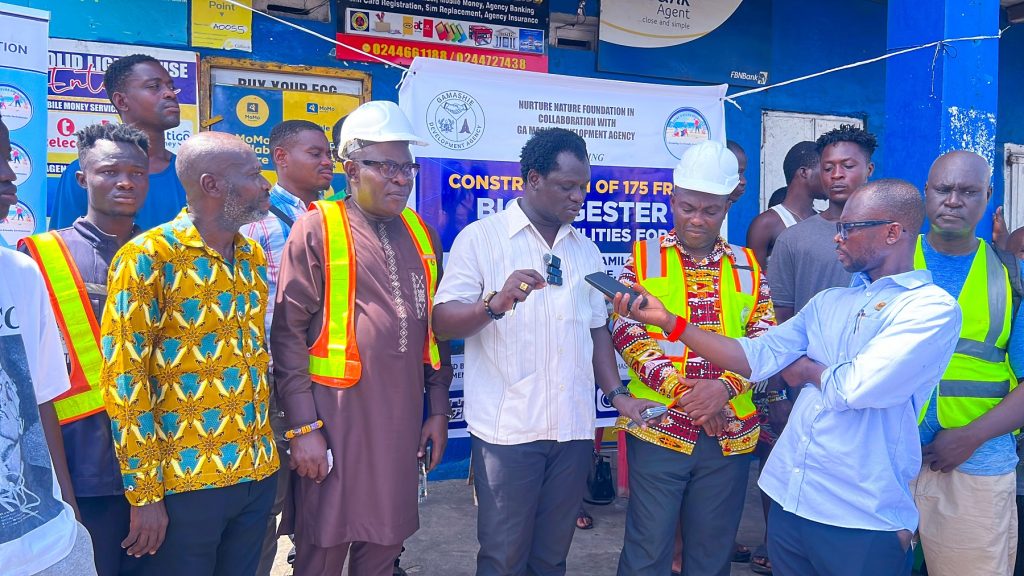
The Ga Mashie Development Agency (GAMADA) serves as the indispensable local link in this project. Under the visionary leadership of Dr. Alfred Dodoo, GAMADA has transitioned from a mere administrative body to a proactive development engine.
Space Clottey, the Deputy Executive Director of GAMADA, has been the “boots on the ground,” navigating the complex social fabric of Jamestown. His role involved mediating between families in compound houses, managing land-space disputes, and ensuring that the construction teams had the necessary access to the narrowest alleys of Old Accra. GAMADA’s involvement ensures that the project is not seen as an “outsider intervention” but as a community-owned advancement.
6.2 The Assembly’s Role: Carlos Nii Ayaa Mankattah
Development does not happen in a political vacuum. The support of Carlos Nii Ayaa Mankattah, the Assembly Member for the Kinka (Bukom) Electoral Area, was pivotal. Popularly known and respected in the Odododiodio Constituency, Mr. Mankattah provided the political “Social License to Operate.”
At the launch, he reminded residents of the power of local governance. He linked the project’s success to the community’s ability to elect development-focused leaders. By commending both GAMADA and the Nurture Nature Foundation, he helped bridge the gap between the municipal government (Accra Metropolitan Assembly) and civil society. His presence at the launch was a testament to the fact that when local politicians, NGOs, and international donors align, the result is tangible relief for the people.
PART IV: HUMAN IMPACT AND TESTIMONIALS
CHAPTER 7: RESTORATION OF HUMAN DIGNITY
7.1 The Case of Naa Adoley: A Matriarch’s Relief
The most poignant moment of the project launch was the visit to the household of Naa Adoley, one of the first three pilot beneficiaries. Her story is the story of thousands in Ga Mashie. For decades, Naa Adoley—now an elder in her community—had to wake up in the early hours of the morning to beat the queues at the public toilet.
“The toilet has proven to be a particular blessing for the elderly members of myhousehold,” she told the media team. For the elderly, the lack of a home toilet is not just an inconvenience; it is a physical hardship. Walking long distances on uneven ground at night is a safety risk, and the “poverty of time” spent inqueues is a theft of their remaining years. The bio-digester unit, installed just steps from her living area, has restored her dignity and provided her with the comfort she deserves in her twilight years.
7.2 Safety for Women and Children in Urban Alleys
Beyond the elderly, the project has a profound impact on the safety of women and children. In high-density areas like Jamestown, the walk to a public facility at night can expose women to harassment or assault. By moving the sanitation facility inside the safe perimeter of the compound house, the Nurture Nature Foundation is actively contributing to the safety and security of the community’s most vulnerable members.
Space Clottey noted that young children often cannot afford the small fees charged at public toilets, which leads to “emergency” open defecation in gutters. The 175 free units eliminate this financial barrier, ensuring that the next generation of Ga Mashie residents grows up in a hygienic environment where their basic needs do not come at a cost they cannot afford.
CHAPTER 8: SOCIAL ENGINEERING AND BEHAVIORAL CHANGE
8.1 Overcoming the Habit of Open Defecation
Technology is only half the battle; the other half is behavioral. For generations, the beach has been the “default” toilet for many. Peter Asiedu acknowledged that changing this habit requires constant engagement. The project includes a “Social Engineering” component where community leaders explain the link between beach defecation, contaminated fish, and the community’s high rates of typhoid.
8.2 The “Sanitation Ambassador” Model
Naa Adoley has become an accidental “Sanitation Ambassador.” By opening her home to the media and her neighbors to show the odorless, clean bio-digester, she is doing more to change minds than any billboard could. Her appeal to the funders to “extend the initiative to additional households” reflects the growing community demand. Residents are seeing the pilot units and realizing that they no longer have to accept the “stigma of the beach.”
PART V: SUSTAINABILITY AND SCALING
CHAPTER 9: THE MAINTENANCE ECOSYSTEM
9.1 Training the Five-Member Technician Team
A recurring failure in developmental projects is the lack of a maintenance plan. The Nurture Nature Foundation has proactively addressed this by identifying and training five community members to handle the long-term sustainability of the bio-digesters.
These technicians are trained in:
1. Biological Health: Monitoring the enzyme levels in the digester to ensure
solid waste continues to break down efficiently.
2. Structural Maintenance: Repairing any leaks or blockages in the inflow
pipes.
3. Community Education: Acting as first responders to teach families how to
care for their units (e.g., what chemicals not to pour down the drain that
might kill the beneficial bacteria).
This “Exit Strategy” ensures that when the Nurture Nature Foundation eventually concludes its primary construction phase, the expertise remains in Ga Mashie, creating jobs and ensuring the 175 units last for 20 years or more.
CHAPTER 10: THE ROADMAP TO 1,000 HOUSEHOLDS
10.1 The Call to Corporate Ghana
Peter Asiedu’s remarks at the launch were a clarion call. “The 175 from Selavip is not enough for the people of Ga Mashie,” he stated. While Selavip has provided the foundation, the scale of the need requires local corporate support.
NNF is currently designing a “Corporate Sanitation Partnership” program, inviting Ghanaian banks, telecommunications companies, and manufacturers to “adopt a street” in Jamestown. By funding the next 825 units, corporate Ghana can help GAMADA reach its target of 1,000 households—the “tipping point” required to officially declare Ga Mashie an “Open Defecation Free” (ODF) zone.
10.2 Replicating the Ga Mashie Model Nationally
The success of the pilot units has already drawn interest from other coastal districts. The combination of decentralized technology (bio-digesters), international philanthropic funding (Selavip), and local development agency coordination (GAMADA) is a blueprint that can be exported to Chorkor, Teshie, La, and beyond.
PART VI: THE TECHNICAL COMPENDIUM AND OPERATIONAL MANUAL
CHAPTER 11: ENGINEERING PRECISION IN CONGESTED SPACES
11.1 The Challenge of Urban Micro-Geography
The Ga Mashie community presents a unique set of architectural and geographical challenges. The “compound house” structure, common in Jamestown and Ussher Town, consists of multiple rooms opening onto a central courtyard. These structures are often separated by alleys—some no wider than three feet. Traditional sanitation solutions, which require heavy machinery for excavation and large trucks for waste removal, are physically impossible here.
The Nurture Nature Foundation’s engineering team, led by Peter Asiedu, had to design a “surgical” installation process. This chapter outlines the technical specifications that make the bio-digester the only viable solution for such a micro-geography.
11.2 Detailed Bill of Quantities (BOQ) and Materiality
For a professional project of this scale, transparency in the supply chain is paramount. Each of the 175 units follows a standardized material list, ensuring quality control across the community.
1. Substructure and Excavation:
- Manual Excavation: Due to the density, all pits are hand-dug to a depth of 1.2 meters. This prevents damage to neighboring shallow foundations.
- Reinforced Concrete Slabs: Each unit uses 42.5R grade Portland cement, mixed with local river sand and 1/4-inch crushed granite.
2. The Digester Core:
- Bio-Filtration Media: This is the “heart” of the system. It consists of a specific gradation of activated charcoal (for odor adsorption), silica sand (for pathogen filtration), and organic fibers (coconut husks) which serve as a breeding ground for aerobic bacteria.
- Biological Inoculum: A proprietary enzyme blend is introduced at the star of the unit’s life to jumpstart the decomposition of organic solids.
3. Superstructure and Plumbing:
- Micro-Flush Pedestals: Selected for their water-saving capabilities, these units require only 1.5 to 2 liters per flush, preserving the community’s limited water supply.
- Ventilation Systems: A 2-inch PVC “T-Vent” system is installed to ensure a constant supply of oxygen to the bacteria, which is the key to the odorless operation confirmed by the pilot study households.
11.3 The Construction Methodology: A Step-by-Step Guide
The project employs a 10-step construction protocol:
- Site Assessment: Engineers and GAMADA officers verify the space and ensure no underground utility lines (water or electricity) are compromised.
- Excavation: Local labor is used to dig the containment pit.
- Base Lining: The pit is lined with a semi-permeable membrane to allow treated effluent to seep out while keeping solids contained.
- Chamber Installation: The pre-cast or in-situ concrete chamber is fitted.
- Media Layering: The charcoal, sand, and husks are layered in a specific order (The “Bio-Filter Cake”).
- Plumbing Connection: Connection of the micro-flush seat to the digester.
- Venting: Installation of the vent pipe, extended above the roofline of the compound to ensure air circulation.
- Sealing: The top slab is sealed with a gas-tight gasket to prevent odors.
- Priming: The enzyme inoculum is flushed into the system.
- Handover: The family is trained on the “Rules of Use”—specifically the avoidance of harsh chemicals like bleach, which can kill the helpful bacteria.
PART VII: THE BLUE ECONOMY AND SOCIO-ECONOMIC FORECASTING
CHAPTER 12: SANITATION AS AN ECONOMIC MULTIPLIER
12.1 Reclaiming the Jamestown Coastline
Peter Asiedu’s vision for Ga Mashie as a “tourist attraction center” is grounded in the economic theory of the Blue Economy. Currently, the economic potential of the Jamestown beach is suppressed by the presence of fecal matter. This not only discourages international tourists but also lowers the value of the “Jamestown Brand.”
By installing 175 toilets, the Nurture Nature Foundation is removing roughly 2,000 to 3,000 kilograms of fecal matter from the coastal environment every single month. When the project scales to 1,000 units, the impact will be total coastal restoration.
12.2 The Tourism Value Chain
A clean Ga Mashie coastline unlocks several economic tiers:
- Tier 1: Heritage Tourism: Visitors coming to James Fort and the Lighthouse will stay longer and spend more if the surrounding environment is hygienic.
- Tier 2: Hospitality Growth: The absence of odors and beach pollution encourages the development of “boutique” guest houses within the historic community.
- Tier 3: The Boxing and Culture Nexus: Ga Mashie is the world capital of boxing (Bukom). Sanitation improvements make it a more viable site for international sports tourism and cultural festivals.
12.3 Dr. Alfred Dodoo’s “Hope” Index
Dr. Alfred Dodoo’s “excitement and hope” are not just emotional responses; they are based on the “Hope Index” of the community. When a community sees modern infrastructure being built for free, the “Social Capital” increases. Residents begin to invest in their own homes—painting walls, fixing roofs, and starting small businesses—because they feel the community is “on the rise.” The 175 toilets are a catalyst for a billion-cedi revitalization of Old Accra.
PART VIII: ENVIRONMENTAL SCIENCE AND CLIMATE RESILIENCE
CHAPTER 13: ADAPTING TO A CHANGING COASTLINE
13.1 High Water Tables and Salinity
Ga Mashie is a coastal community, which means the soil has high salinity and a high water table. Traditional pit latrines in this area are an environmental disaster; they frequently flood during high tide, leaching raw sewage directly into the groundwater.
The Nurture Nature Foundation’s bio-digester is Climate-Resilient.
1. Water-Tight Integrity: The units are designed to be water-tight, preventing groundwater from entering the system and preventing untreated waste from escaping.
2. Salt-Resistant Materials: The use of PVC and high-grade treated concrete ensures that the salty sea air does not corrode the infrastructure, a critical factor for long-term sustainability.
13.2 Pathogen Reduction and Public Health
The bio-digester is a “biological shield.” By using aerobic digestion, the system kills 99% of the pathogens found in human waste. In a community where children often play barefoot in communal courtyards, this reduction in soil-transmitted helminths (worms) and fecal coliforms is a life-saving intervention. The data from the pilot phase suggests that households with these units see a marked decrease in “stomach-related” clinic visits within the first 90 days.
PART IX: POLICY ALIGNMENT AND GLOBAL ADVOCACY
CHAPTER 14: THE GHANAIAN MODEL FOR SDG 6
14.1 Meeting the UN Sustainable Development Goals
This project is a primary contributor to SDG 6: Clean Water and Sanitation. It specifically addresses Target 6.2, which calls for an end to open defecation and access to adequate and equitable sanitation. By targeting low-income households in Ga Mashie, NNF and Selavip are practicing “Equity in Action.”
14.2 Advocacy and National Policy
The Ga Mashie project serves as a “Policy Laboratory” for the Ghanaian Ministry of Sanitation and Water Resources. While the government has struggled with large-scale centralized sewerage, the NNF-GAMADA model proves that Decentralized Sanitation is faster, cheaper, and more effective for urban slums.
Carlos Nii Ayaa Mankattah’s advocacy at the Assembly level is crucial here. He is using the 175-unit rollout to argue for a change in municipal bylaws—moving away from the “public toilet only” model toward a “household toilet” model, which is proven to be more hygienic and dignified.
PART X: THE ROAD TO 1,000 AND BEYOND
CHAPTER 15: CONCLUSION AND THE CALL TO ACTION
15.1 The Legacy of May 4, 2026
The launch of this project will be remembered as the day Ga Mashie began its “Sanitation Independence.” The partnership between the Nurture Nature Foundation, GAMADA, and Selavip has set a standard that few thought possible.
15.2 The 1,000-Unit Vision
We conclude this report with a clear roadmap. The 175 units funded by Selavip are the foundation. To reach the 1,000-unit target, we require a collective effort.
- To Corporate Ghana: We invite you to join Peter Asiedu and Dr. Alfred Dodoo. Your CSR dollars can buy more than just branding; they can buy health and dignity for the people of Old Accra.
- To the People of Ga Mashie: The facilities are yours. As Naa Adoley showed these toilets are a “blessing” that must be protected and maintained for the generations to come.
As the sun sets over the Jamestown Lighthouse, the three pilot toilets standsilent and odorless—a quiet proof that the future of Ga Mashie is clean, it is hopeful, and it is here.
APPENDICES
– Appendix A: Full Technical Drawings and Sectional Views.
– Appendix B: Household Vetting and Selection Criteria Documents.
– Appendix C: Maintenance Log Templates for the 5-Member Team.
– Appendix D: Formal Speeches of Peter Asiedu and Dr. Alfred Dodoo.